Atum and Eden: Two Accounts of How the World Began
Compare the Heliopolitan creation story of Atum with Genesis and see how Scripture presents God, creation, and humanity differently.
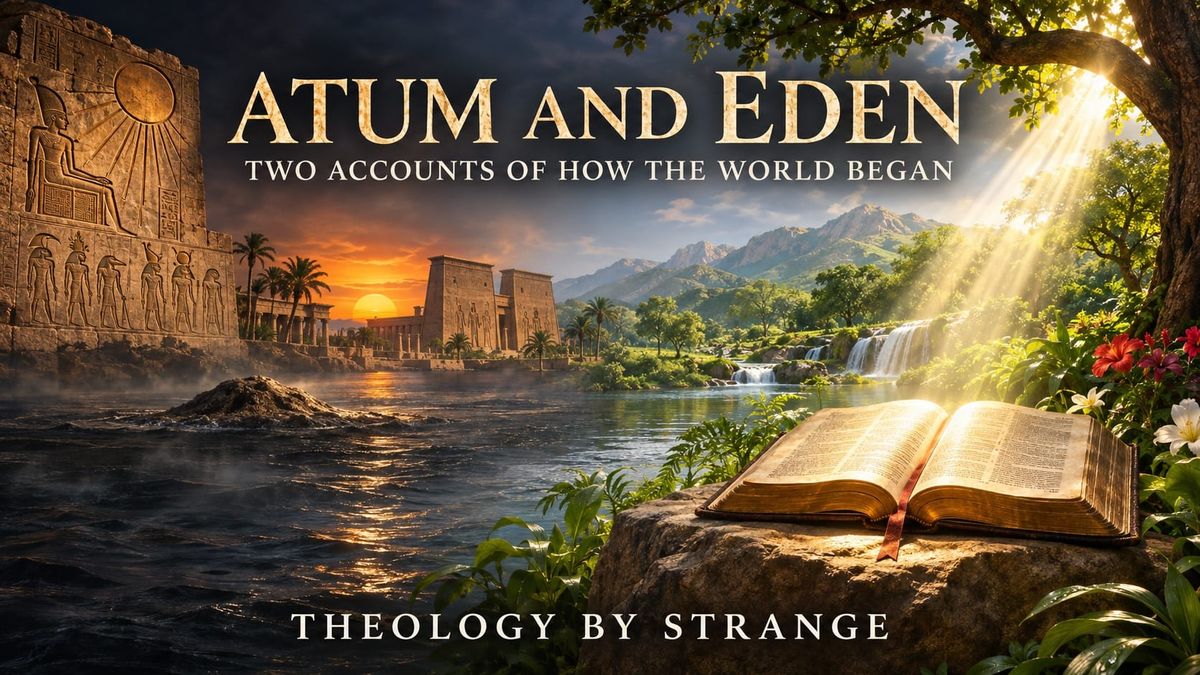
Ancient Egyptians did not tell just one creation story. Different religious centers preserved different accounts of how the world began, and later traditions sometimes blended ideas from them. One of the best-known accounts is the Heliopolitan cosmogony, associated with the sun-god Atum and the city of Heliopolis. It gives us a useful point of comparison with the opening chapters of Genesis—but the two accounts do not teach the same thing about God, creation, or humanity.
Atum and the first beginning
In the Heliopolitan story, before the ordered world existed, there was Nun, the primordial expanse of waters. Atum came into being from this beginning and appeared on the first mound. He then brought forth the first divine pair, Shu and Tefnut. In turn, they became the parents of Geb, the earth, and Nut, the sky. The generations continued until the family of gods known as the Ennead was formed: Atum, Shu, Tefnut, Geb, Nut, Osiris, Isis, Seth, and Nephthys.
Ancient Egyptian sources do not preserve this story as one tidy, uniform narrative. The details and names vary across texts and periods. In some accounts, Atum is closely identified with the sun-god Re, and his creation of Shu and Tefnut is described in different ways. The central idea remains: the ordered world and its divine powers emerge through Atum and the generations of gods. James P. Allen’s study of Egyptian creation accounts and Raymond O. Faulkner’s translation of the Pyramid Texts help show how these ideas appear in the ancient sources.
This was a religious account, not merely an early scientific guess. It expressed Egyptian beliefs about the divine world and the source of its order. From the standpoint of biblical Christianity, those claims are not true revelation about God. They are evidence of what ancient Egyptians believed, and they should be read as the religious teachings of a different faith.
The Creator and creation in Genesis
Genesis begins differently: “In the beginning, God created the heavens and the earth” (Genesis 1:1, ESV). The one God is already there before anything else. He does not emerge from primordial water, and he is not one member of a divine family. The waters, the sky, the land, the sun, and the moon are all part of what God made and ordered (Genesis 1:3–10, 14–18).
That difference matters. In the Heliopolitan account, divine beings are woven into the structure of the world: Geb is earth, and Nut is sky. In Genesis, the heavens and earth are not gods. They are creatures, dependent on their Maker. The sun and moon are not divine rulers, either; they are lights appointed by God to serve his created order. Scripture presents God as sovereign over creation, not as one power inside it (Psalm 33:6; Isaiah 45:18).
Genesis also does not describe creation as a family tree of gods. God speaks, and what he commands comes to be. His word establishes boundaries and gives the world its order. There is no divine rivalry or struggle in the creation account. The repeated declaration that creation is good shows that the world is not the accidental byproduct of divine reproduction or conflict (Genesis 1:4, 10, 12, 18, 21, 25, 31).
Humanity’s place in the world
The contrast continues when the stories turn to humanity. In Genesis, men and women are made in God’s image and given a meaningful vocation within creation: they are to fill the earth and exercise stewardship over it (Genesis 1:26–28). The second creation account says God formed man from the dust and breathed life into him (Genesis 2:7). Human beings are creatures, not gods, but their lives carry dignity and responsibility because God made them.
The Heliopolitan account is chiefly concerned with the emergence of the gods and the cosmic order. It does not give humanity the same central role that Genesis gives to image-bearing men and women. This is not a small difference in emphasis. Genesis tells us that human life belongs within God’s good creation and that our work is accountable to him.
That calling was damaged by sin, but Scripture’s story does not end in Eden’s expulsion. The God who made all things also redeems sinners through Jesus Christ. The New Testament identifies Christ as the one through whom all things were created and in whom they hold together (John 1:1–3; Colossians 1:16–17). The Bible’s account of creation therefore leads into its account of sin, promise, and redemption.
Reading the comparison carefully
Comparing Genesis with Egyptian creation traditions can help us understand the religious world of the ancient Near East. It can show us how different peoples spoke about origins, divine power, and the order of the world. But similarity in subject matter does not make the accounts equally true, nor does it prove that Genesis borrowed its teaching from Egypt. The Christian reader receives Genesis as Scripture: its witness is that the one God freely created all things and remains Lord over them.
Atum’s story describes a world emerging through a divine genealogy. Eden’s story presents a world made and ordered by the living God, who creates humanity for life with him and gives them work to do. The first is a record of ancient Egyptian religion; the second is the biblical testimony on which Christian faith rests.
We write about Scripture and the ancient world, seeking to see every story in the light of God’s Word.
If this post helped you, subscribe to Theology by Strange and become a member for more studies on Scripture, history, and the ancient world.