Why Theology Must Serve the Life of Faith
Why Christian theology is not abstract theory but essential to the life of faith, shaping worship, obedience, and hope in Christ.
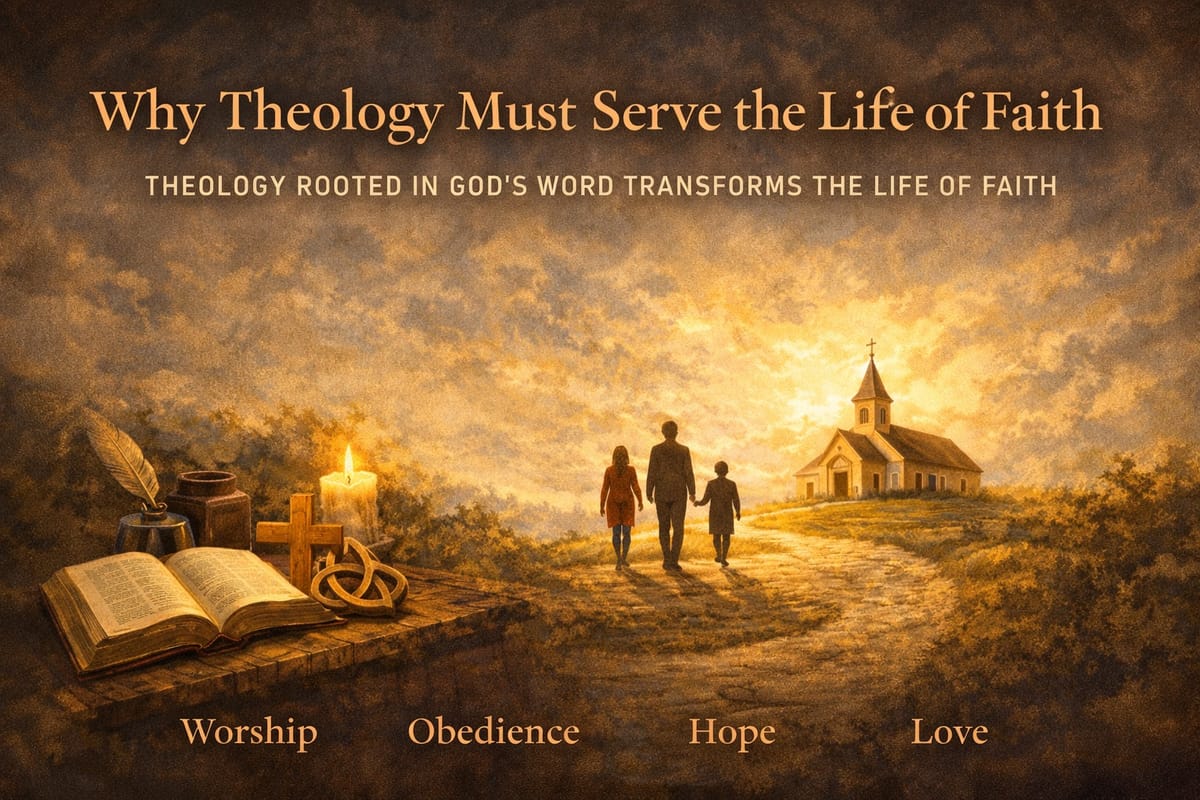
Theology is not an abstract luxury. It is the furnishing of the soul.
A house without furniture may still stand, but it feels bare, cold, and unwelcoming. In the same way, a Christian life without sound doctrine lacks the structure and warmth needed for endurance and joy. The truths of Scripture are not decorative pieces to admire from a distance. They are the provisions by which the life of faith is sustained.
The doctrines of God, of Christ, of the Spirit, of the church, of redemption—these are not merely topics to be catalogued in systematic outlines. They are living realities to be received, confessed, and embodied. To know the Trinity is to understand the God in whose image we are made. To know Christ is to enter the mystery of salvation. To know the Spirit is to experience the power that sanctifies, sustains, and preserves.
When the apostle Paul exhorted Timothy to “guard the good deposit entrusted to you” (2 Timothy 1:14), he was not urging him to protect an academic theory. He was charging him to preserve a life-giving treasure. Likewise, when Paul instructed Timothy to teach and remind the church of sound doctrine (1 Timothy 4:6; 2 Timothy 2:2), he was not calling for intellectual performance or scholarly display. He was calling for pastoral faithfulness.
Doctrine, for Paul, was never an end in itself. It existed for the sake of the church’s life.
The goal of theology was not pride of knowledge, but the fruit of faith: lives transformed, believers equipped to love God and neighbor with sincerity, hearts anchored in hope during suffering, and courage formed in the face of compromise. Sound doctrine strengthens the weak, comforts the afflicted, humbles the proud, and emboldens the fearful. It gives clarity when confusion presses in and stability when the ground beneath our feet feels uncertain.
When theology fails to serve life—when it remains abstract, detached from worship, morality, relationships, and vulnerability—it has missed its God-given purpose. Truth is not meant to hover above us as disembodied theory. It is meant to enter the fabric of our existence. It must shape how we pray, how we forgive, how we endure suffering, how we rejoice, and how we walk faithfully in obedience.
Theology that does not lead to doxology and obedience has failed to be truly theological.
History bears sober witness to what happens when doctrine is separated from discipleship. The results are predictable and tragic: shallow faith that cannot endure hardship, moral drift that bends with cultural pressure, confusion where clarity once stood, and despair where hope should dwell. In such seasons, theology becomes an intellectual exercise rather than a lived confession, and the people of God suffer for it.
But where truth is embraced with faith and lived out in obedience, grace flourishes.
When believers not only affirm the doctrines of Scripture but embody them, the fruit is unmistakable—deepening holiness, resilient hope, enduring love, and abiding joy. In such communities, doctrine does not lie dormant on the page. It is written on the heart. It shapes worship, orders relationships, and sustains perseverance.
This work is written out of that conviction: that systematic theology, rightly done, always serves the life of faith. Its purpose is not to inflate knowledge for its own sake, but to direct both mind and heart toward the living God. Theology is meant to lead us beyond understanding alone, into deeper worship, stronger faith, and truer obedience.
May your roots grow deeper into the truth of God’s Word. May your life be anchored more firmly in his promises. And may the doctrines of the faith, studied carefully and lived faithfully, bear fruit in love, holiness, and joy.
Theology is not meant to impress the mind alone, but to shape the life that stands before God.
— Zach Strange
If this kind of theological reflection is helpful to you—grounded in Scripture, shaped by the life of the church, and aimed at faithful Christian living—I invite you to subscribe to Theology by Strange. Becoming a member helps sustain this work and ensures you don’t miss future posts as we continue to think carefully and live faithfully before God.