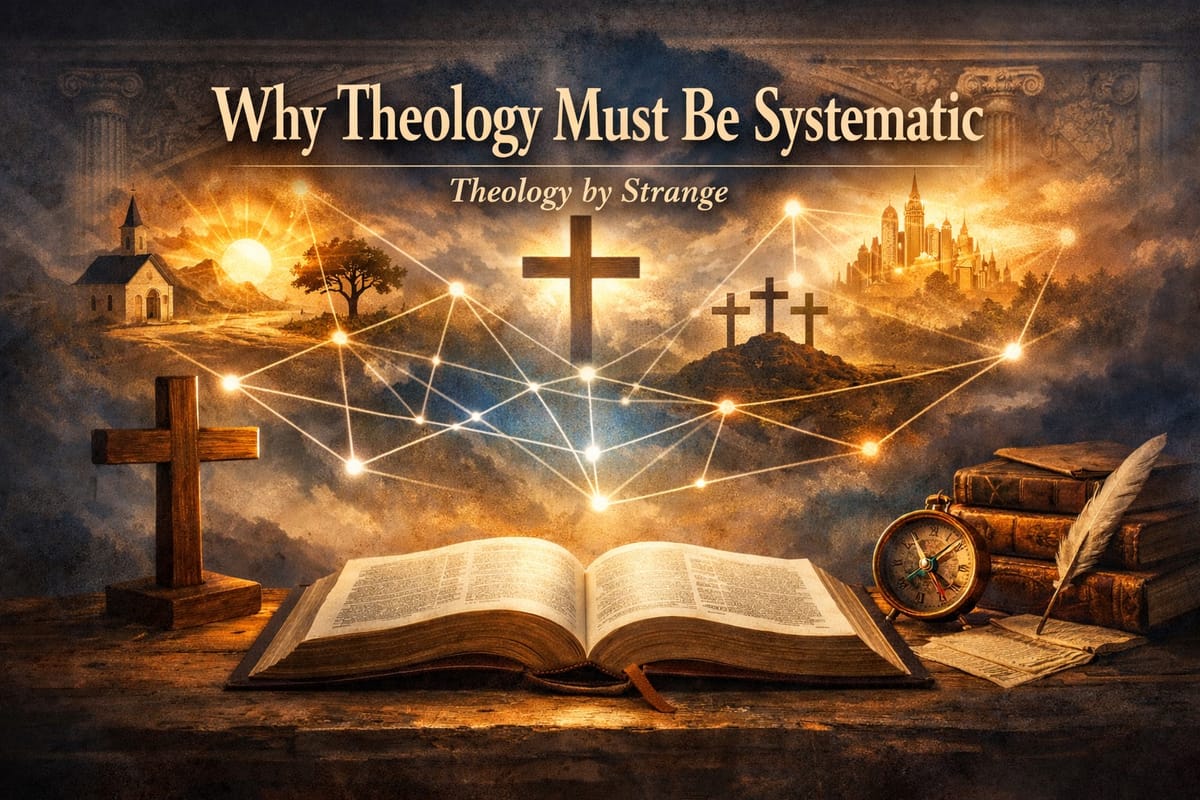
Why Theology Must Be Systematic
Christianity is not a collection of fragments but a unified revelation. Here's why systematic theology matters for faithful Christian belief.
Christianity is not a loose collection of religious ideas or a grab bag of moral advice. At its core, the Christian faith is the revelation of a coherent, ordered, and living truth. Scripture does not present us with fragments to be assembled at will, but with a unified witness to who God is, what He has done, and what He is doing in the world.
The God who reveals Himself in Scripture is not a God of confusion, but a God of order, harmony, and purpose (1 Corinthians 14:33). Because God is one, truthful, and unchanging, His revelation is also unified. What He says about creation cannot contradict what He says about salvation. What He reveals about humanity cannot be detached from what He teaches about sin, redemption, and glory. From Genesis to Revelation, the Bible tells one unfolding story with divine consistency.
This is why theology must be systematic.
Systematic theology is often misunderstood as an attempt to force the Bible into neat human categories—as if we were imposing logic onto God rather than listening to Him. In reality, the opposite is true. Systematic theology is a humble and reverent effort to recognize the order already present in God’s self-disclosure. It does not invent coherence; it confesses it. It does not construct truth; it receives it.
When Scripture is read carefully and faithfully, it speaks with one voice. Systematic theology simply traces that voice across the whole canon. It gathers what God has said in many places and shows how those truths relate to one another. Creation, sin, salvation, providence, judgment, and glory are not isolated doctrines—they belong together within the single, grand narrative of redemption.
The real question, then, is not whether we will think theologically, but whether we will think rightly about what God has revealed.
Every Christian already holds theological beliefs. We all have views about God, humanity, salvation, purpose, and destiny. The issue is whether those beliefs are shaped by the full teaching of Scripture or by fragments—personal preference, cultural assumptions, or favorite verses pulled out of context. Partial truths, when left uncorrected, eventually become distortions.
Systematic theology helps guard the church against this danger by pressing us to listen to the whole counsel of God. It teaches us to let Scripture interpret Scripture, and to hold each doctrine in proper proportion to the rest. Far from diminishing mystery, this approach honors revelation. It acknowledges that while God is infinite and beyond full comprehension, He has spoken clearly and consistently.
To think systematically is not to reduce God to a formula. It is to approach His Word with reverence and trust—believing that the truth He reveals is unified, trustworthy, and glorious, because its Author is the God of perfect wisdom and unchanging truth.
Truth is not scattered. God has spoken with purpose—and He invites His people to listen carefully.
— Zach Strange