The Lost Vision
Why modern Christians struggle to see creation as God's self-disclosure - and how Scripture calls us to recover wonder, beauty and faith.
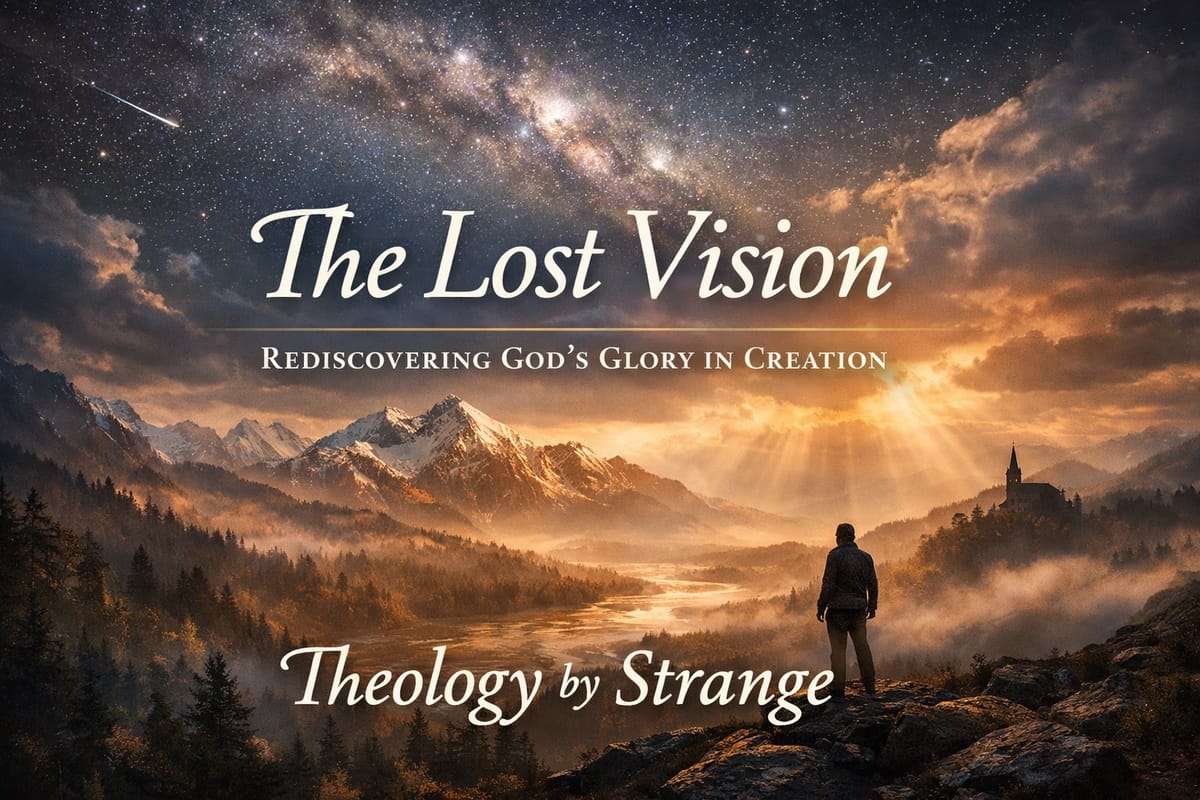
We do not live in an age that lacks information about God. We live in an age that has lost the ability to see.
We are surrounded by data, measurements, studies, and endless explanations. We can analyze nearly everything—yet we struggle to experience wonder, meaning, or awe. Once, men stood beneath the night sky and felt small in the best possible way. The heavens did not merely inform them; they addressed them. Creation was not just something to be studied, but something that spoke—a living work of art bearing the signature of its Maker.
Today, those same heavens are scanned, catalogued, and quantified. We know their mass, distance, and composition. But their message often goes unheard. What was once received as revelation is now treated as raw material—useful, impressive, but silent. The world has been flattened into a mechanism, efficient and predictable, stripped of mystery.
And in the process, we have forgotten ourselves.
When humanity loses sight of God in creation, it loses sight of what it means to be human. Made in the image of God, we were meant to encounter the world as a place of divine self-disclosure—a theater of God’s glory. Instead, we increasingly see creation as a projection of our own desires and powers. We study it, manage it, exploit it—but no longer receive it.
The tragedy of our age is not ignorance. It is blindness. Scripture assumes a very different way of seeing.
“The heavens declare the glory of God, and the sky above proclaims his handiwork” (Psalm 19:1).
That confession rests on a profound assumption: the world is intelligible because it is personal in origin. Creation speaks because its Maker speaks. Its patterns, beauty, and order are not accidents, but echoes of divine wisdom. Mountains preach stability. Stars proclaim order. The rhythm of breath testifies to dependence. Even silence bears witness to the God who upholds all things.
Paul echoes this truth when he writes that “since the creation of the world God’s invisible qualities—his eternal power and divine nature—have been clearly seen” (Romans 1:20). The knowledge of God is not hidden away in secret rites or philosophical puzzles. It is openly displayed, pressed into the structure of reality itself. Every sunrise summons gratitude. Every breath invites acknowledgment.
The universe is not an obstacle to faith.
Yet modernity has trained us to distrust this testimony. The world is no longer encountered as creation—gifted and meaningful—but as coincidence. Wonder has slowly hardened into disenchantment. What once inspired reverence now invites only explanation. Max Weber famously described this shift as the collapse of a “sacred canopy,” a world no longer perceived as charged with transcendence (as Charles Taylor discusses in A Secular Age).
Earlier generations looked outward and upward with awe. Modern culture looks inward or downward, searching for control rather than meaning. The nineteenth century announced the death of God with confidence. The twentieth quietly buried meaning alongside Him. The result is a civilization surrounded by marvels—galaxies, genomes, consciousness—yet strangely unmoved by them.
Christian theology has never accepted this division between creation and revelation. From the earliest centuries, the Church has spoken of the world as the theatrum gloriae Dei—the theater of God’s glory. Creation was never meant to compete with Scripture, but to harmonize with it. The physical universe reveals real truths about its Creator, not saving truths, but genuine ones.
Every part of the cosmos offers silent testimony. The smallest grain of sand and the farthest star proclaim that the world is ordered, sustained, and intentional. These signs do not replace God’s Word; they prepare us to hear it. They remind us daily that we live in a world upheld by wisdom and grace.
Human reason, when honestly directed toward creation, cannot help but notice these traces. Beauty, order, and persistence all point beyond themselves. Creation extends revelation outward into daily life, making the knowledge of God inescapably public.
Recovering this vision requires a change in posture. We must move from dissecting the world to receiving it. From constant analysis to quiet wonder.
Hans Urs von Balthasar warned that theology cut loose from beauty loses its power to draw the soul toward God (The Glory of the Lord, Vol. 1). Beauty is not decoration. It is truth shining. A mountain at dawn calls us to kneel, not calculate. A child’s laughter reveals something about joy that no equation can measure.
When beauty no longer awakens praise, theology grows cold. Truth becomes abstract. Facts remain, but the fire goes out.
Creation was not given merely to be explained. It was given to be received. In that sense, it functions sacramentally—not as a means of saving grace, but as a sign that points beyond itself. Rivers speak of life. Stars whisper eternity. They invite worship, not possession.
Yet sin distorts our vision. As C. S. Lewis observed, modern humanity has become “men without chests”—capable of analysis but incapable of adoration (The Abolition of Man). The problem is not a lack of intelligence, but a failure of the heart.
Scripture teaches that sight must be restored by faith.
“By faith we understand that the universe was formed at God’s command” (Hebrews 11:3).
Faith does not reject reason; it heals it. It allows us to see the visible world as grounded in unseen reality. When the Spirit opens the eyes of the heart, creation becomes transparent again. A sunrise becomes a psalm. The wind becomes a reminder of breath and dependence. The human face reflects the divine image and dignity.
The Christian is not called to flee the world, but to see it rightly. Beneath the fleeting and the fragile stands the uncreated Light “in whom all things hold together” (Colossians 1:17).
This reflection serves as both lament and invitation. A lament for the blindness that has dimmed the Christian imagination. And an invitation to behold the world once more as God’s self-disclosure—not as an accident, but as a gift.
To see creation rightly is to see it as belonging to Him—formed by His hands, sustained by His grace, and destined for His glory. The song of beauty has not ceased. We have simply forgotten how to listen.
The vision is not lost forever. It waits to be recovered by eyes made new.
Seeing the world again as God’s gift and God’s glory.
— Zach Strange
If this reflection resonated with you, I invite you to subscribe and become a member of Theology by Strange. New essays explore Scripture, theology, and the Christian imagination with depth, clarity, and reverence. Join the community and continue the conversation.