The Knowledge of God and the Human Condition
Every human being lives in relation to God - either through worship or suppression. The Bible teaches that knowing God is not optional, but essential to being human.
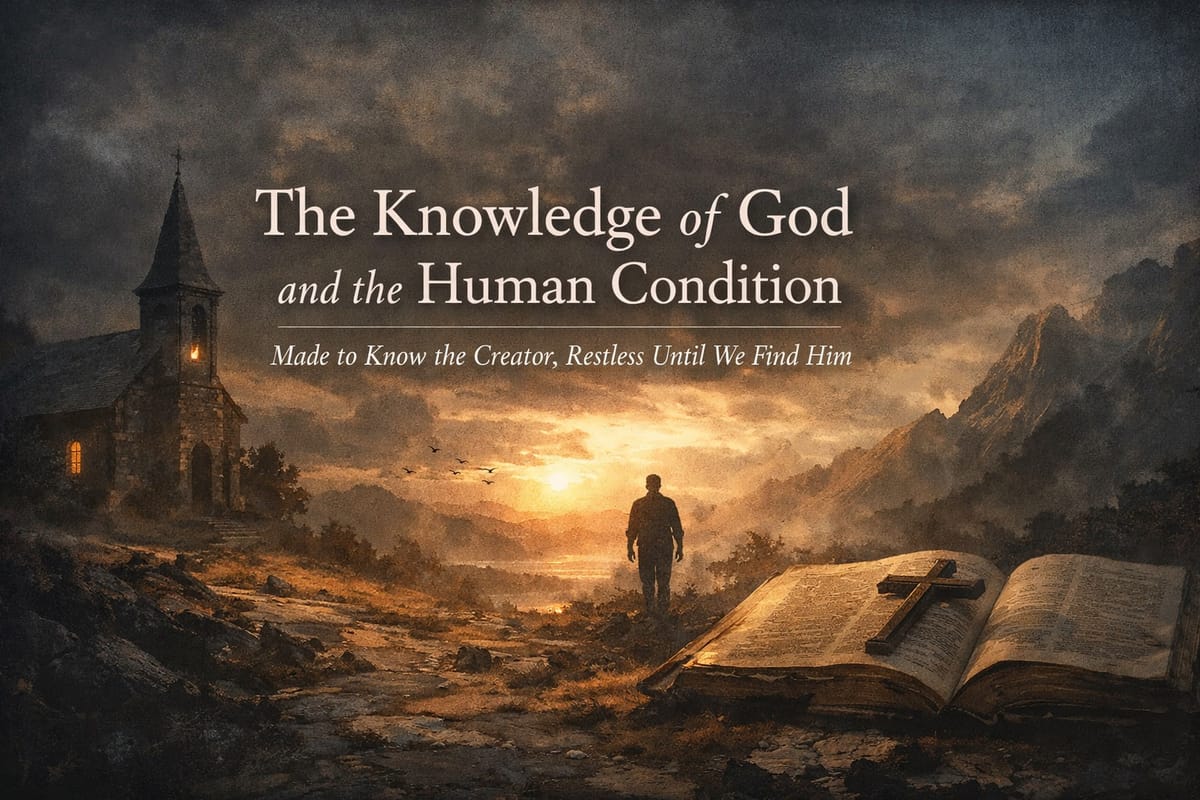
Why does the question of knowing God still matter?
Beneath our philosophies, our politics, our sciences, and even our private griefs, one question refuses to go away: Who is God, and what does it mean to know Him? Every culture wrestles with it. Every human heart circles it. Scripture teaches that this is not accidental. We were made for the knowledge of God. To know Him is not a religious add-on or a spiritual hobby—it is part of what it means to be human.
When that knowledge is ignored or denied, everything else begins to drift. Meaning thins out. Moral confidence grows louder even as wisdom disappears. We gain information but lose orientation. As Ecclesiastes puts it, we find ourselves “chasing after the wind.”
The Myth of Neutrality
Our modern world insists that belief is optional. Faith, we’re told, is a private preference. Convictions should be held loosely. The wise person, according to this story, stays neutral.
But Scripture doesn’t recognize neutrality.
If Christianity is true—if the Bible really is God’s self-revelation—then every human being already lives in relation to Him. The heart never stands still. It always worships. When God is not honored as God, something else takes His place: success, autonomy, politics, pleasure, security, self. What we call unbelief is often not the absence of faith but the misdirection of it.
The Bible names this clearly. Humanity does not fail to know God because He has hidden Himself. Rather, we suppress what we already know. The apostle Paul writes:
“What can be known about God is plain to them, because God has shown it to them” (Romans 1:19).
“So they are without excuse” (Romans 1:20).
God’s existence, power, and moral authority are not whispered faintly from afar. They are woven into the fabric of creation and pressed upon the human conscience. The problem is not lack of evidence—it is resistance.
Knowing God and Knowing Ourselves
This truth was articulated with striking clarity by the Reformer John Calvin, who famously wrote:
“Our wisdom, in so far as it ought to be deemed true and solid wisdom, consists almost entirely of two parts: the knowledge of God and of ourselves.”
Calvin was not talking about academic theology or religious sophistication. He meant the kind of wisdom that reorders a life. To know God rightly is to begin seeing ourselves truthfully: as creatures, not creators; as dependent, not autonomous; as accountable, not self-justifying. And the more clearly we see ourselves, the more urgently we are driven back to God.
This is why Scripture never treats theology as detached speculation. Knowledge of God is always relational, moral, and transformative. It humbles us. It exposes us. And it restores us.
The Inescapable Knowledge We Resist
The Bible’s claim is bold: everyone knows God exists.
That knowledge may be buried, resisted, distorted, or denied—but it is not absent. Calvin called it the sensus divinitatis, the “sense of deity,” placed by God Himself within every human being. Conscience, moral intuition, the hunger for meaning, the ache for justice, the fear of death—all of these echo the same testimony. Even unbelief bears witness to what it resists.
This means atheism is not merely an intellectual position or a neutral lack of belief. Biblically speaking, it is a chosen posture—a way of living as though God were not known, even while His witness persists within. As the psalmist writes:
“The fool says in his heart, ‘There is no God’” (Psalm 14:1).
Scripture does not say the fool lacks intelligence. It says he speaks from the heart. The denial is moral before it is rational.
From Suppression to Restoration
None of this is meant to score points in a debate. The goal is not to win arguments about God’s existence. It is to recover the living knowledge of God—the kind of knowledge Scripture holds out as life itself.
Humanity lives in tension. We bear God’s imprint, yet we live in exile from Him. Creation groans. Conscience accuses. The will resists. We remember Eden without knowing how to return.
And into that fracture comes the gospel.
In Jesus Christ, God does not merely prove His existence—He reconciles sinners to Himself. The knowledge we suppress is replaced with the knowledge we need: forgiven, restored, relational knowledge. Through Christ, the image is healed, worship is redirected, and wisdom becomes possible again. As Jesus prayed, “This is eternal life: that they know you, the only true God, and Jesus Christ whom you have sent” (John 17:3).
Why This Matters Where You Live
This truth reaches into ordinary life.
It shapes how we raise our children—not as accidental beings in a godless universe, but as creatures made by and for God. It reshapes our work—not as meaningless labor, but as a place of witness and obedience. It reframes our habits, our loves, and our hopes—not as self-created purposes, but as responses to a God who has not left Himself without a witness.
To deny God is not freedom. It is a contradiction. To know Him is not a limitation. It is homecoming. We were made to know God. And until we do, nothing else will quite make sense.
We do not search for God as strangers—we remember Him as creatures who have wandered.
— Zach Strange
If this reflection resonated with you, I’d love for you to stay connected. Subscribe to Theology by Strange to receive future essays, reflections, and studies as we explore Scripture, doctrine, and the Christian life together.