The Great Commission as the Root of Theology
Why theology begins with Christ's Great Commission - and why doctrine is essential to faithful discipleship and mission.
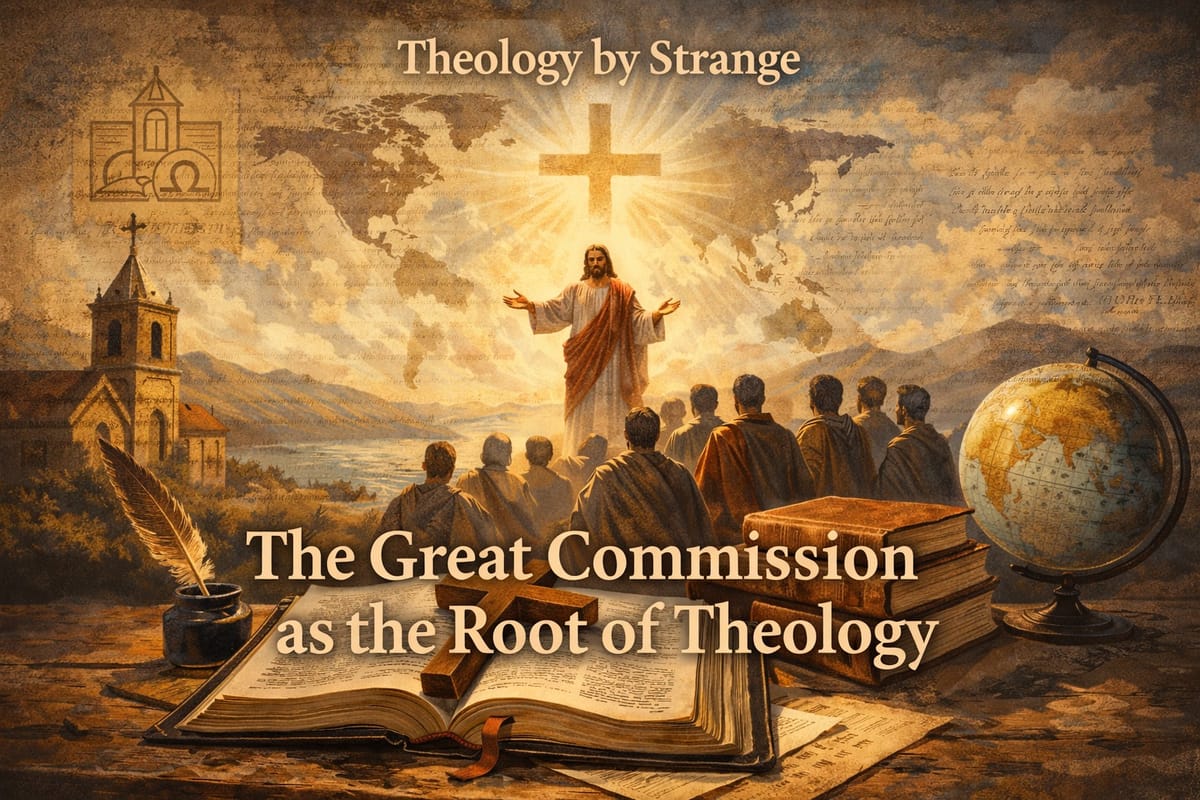
Theology does not begin with human curiosity, intellectual ambition, or the desire to build elaborate systems. It begins with a command.
After His resurrection, Jesus stood before His disciples on a mountain in Galilee and declared, “All authority in heaven and on earth has been given to Me. Go therefore and make disciples of all nations … teaching them to observe all that I have commanded you” (Matthew 28:18–20). In those words, the risen Christ did more than issue a mission strategy. He established the purpose, boundaries, and direction of Christian doctrine itself.
The Great Commission does not merely inspire theology—it governs it. Theology exists because Christ has authorized His Church to proclaim, explain, and embody His truth before the nations. Properly understood, theology is the Church’s obedient effort to articulate and teach everything Christ has commanded, without adding human inventions or subtracting difficult truths. It is not speculation. It is not abstract religious philosophy. It is faith seeking understanding under the authority of the One who sends.
When Jesus commands His disciples to teach others “to observe all that I have commanded,” He places instruction at the very heart of the Church’s mission. This leaves no room for a shallow or purely pragmatic understanding of ministry. Christ does not call His people merely to announce isolated facts or issue motivational slogans. He calls them to sustained, ordered teaching that shapes the mind, forms the heart, and directs the will toward faithful obedience.
The gospel is not only something to be heard—it is something to be learned, internalized, and lived.
For this reason, theology is not reserved for scholars alone. Every faithful teacher in the life of the Church stands under the authority of the Great Commission. Teaching is itself a missionary act, because it is through teaching that God’s truth is preserved, clarified, and passed on from generation to generation and from culture to culture. Doctrine is not what comes after mission; doctrine is how mission accomplishes its goal.
John Calvin captured this reality well when he wrote, “The Lord did not send His apostles to merely make a noise, but to found and build His Church, which He willed to be the mother of all believers” (Institutes of the Christian Religion, 4.1.1). Building the Church requires doctrine that is faithful and coherent. Teaching that doctrine requires theology that listens carefully to Scripture and applies it wisely to God’s people. Without theology, teaching loses substance. Without teaching, the mission loses depth. And without both, the Church fails to mature into the fullness Christ intends.
The Great Commission also provides both the motive and the method for theological study. The motive is obedience to Christ’s command to make disciples of all nations. This is not a suggestion or an optional emphasis—it is a divine mandate that shapes what it means to follow Jesus in the first place. The method is careful attention to God’s Word. The theologian does not invent truth, improve revelation, or supplement Scripture. He gathers, orders, and explains what God has already spoken, so that the Church may grow in faithfulness and love.
As Augustine rightly observed, “Whoever thinks that he understands the divine Scriptures or any part of them, but does not build up the double love of God and of neighbor, does not understand them at all” (On Christian Doctrine, 1.36.40). True theology always moves toward love. It is not an end in itself. It exists to deepen devotion to God and to shape lives of faithful service toward others.
Theology, then, is not a merely academic pursuit. It is an act of worshipful obedience. It is the Church listening carefully to the voice of her Lord so that she may teach faithfully, live rightly, and bear true witness to Christ in the world.
Theology serves the mission of Christ, or it ceases to be theology at all.
— Zach Strange
If you found this helpful, consider subscribing to Theology by Strange. New posts are written to help ordinary Christians think carefully, love God deeply, and live faithfully in the light of Scripture. Membership helps support the work and ensures you never miss future reflections.