The Ancient World of Genesis
Genesis 1 speaks into the ancient world with clarity and power, revealing creation as the intentional act of the one sovereign God.
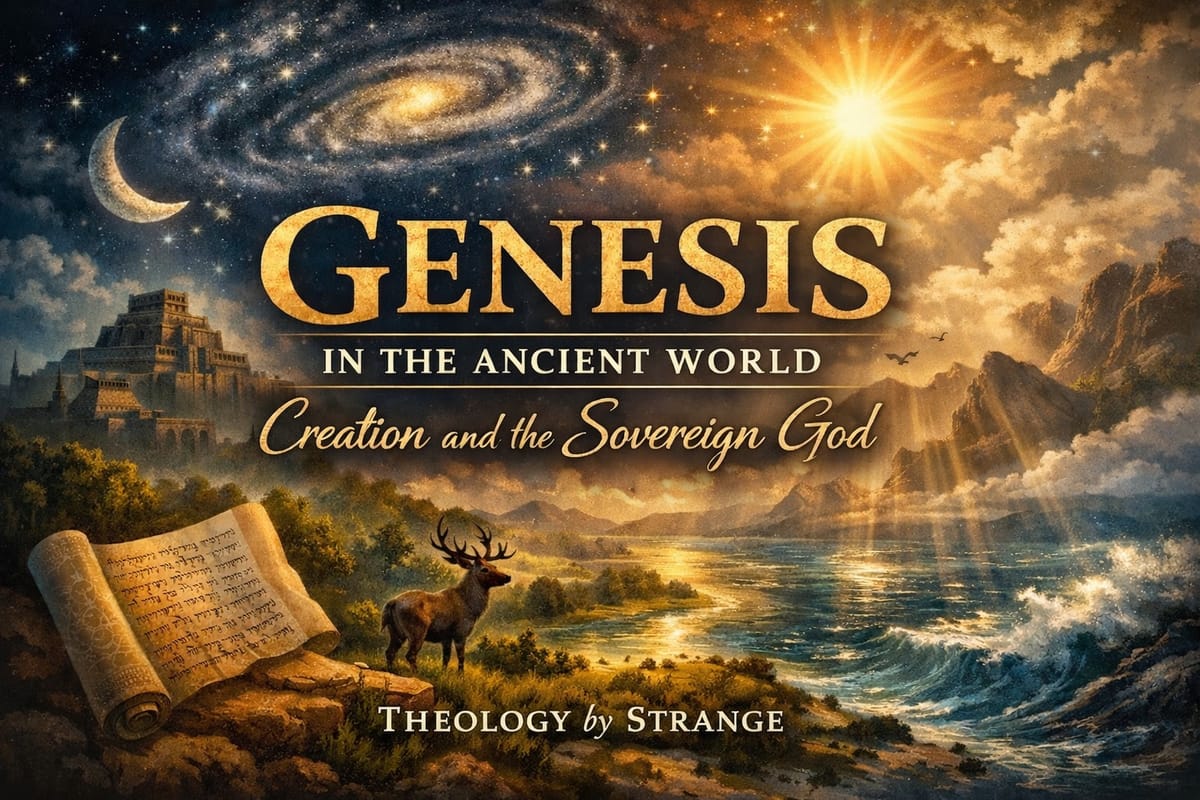
Genesis 1 did not drop from the sky as an isolated or context-free text. It was revealed within a living world—one filled with stories, symbols, and shared assumptions about how reality works. The ancient peoples surrounding Israel—the Babylonians, Egyptians, Canaanites, and others—told their own creation stories. These accounts were not scientific explanations in the modern sense. They were theological narratives, designed to explain why the world exists, how order is maintained, and who ultimately governs reality.
In the Babylonian Enuma Elish, creation begins with conflict. The god Marduk defeats the chaos-dragon Tiamat, splits her body, and fashions the heavens and the earth from the remains. His victory establishes order, assigns functions to the gods, and secures his kingship over the cosmos (Heidel, The Babylonian Genesis, 1951). The point of the story is not how matter came into existence, but how authority was established and why the world functions under Marduk’s rule.
Egyptian creation traditions tell a similar story in a different key. They speak of the zep tepi—the “first occasion”—when the gods emerged from the primordial waters and set the sun, moon, and land in their proper places (Hornung, Conceptions of God in Ancient Egypt, 1982). Creation is portrayed as the establishment of relationships, boundaries, and roles that sustain both divine and human life. Again, the concern is not material mechanics but meaning, order, and purpose.
These ancient texts help us see something crucial: the people of the ancient Near East were not asking the same questions modern readers often bring to Genesis. They were not primarily concerned with atoms, particles, or the age of the universe. They wanted to know who rules the world, why chaos does not prevail, and what place humanity holds within the cosmic order. Creation accounts functioned to affirm divine authority, explain social and moral structures, and locate human life within a meaningful framework.
It is into this world that Genesis 1 speaks—and it does so with remarkable clarity and restraint.
Like the surrounding cultures, Genesis speaks of ordering, separating, naming, and assigning function. But it does so without mythic violence or divine rivalry. The God of Israel does not battle chaos, negotiate with other gods, or rise to power through conquest. He speaks—and order comes to be. Light appears. Time is structured. Sky and land are set in place. Life fills the world, not as competing divine realms, but as domains governed by one sovereign Creator.
This is where the polemical force of Genesis becomes clear. Creation is not the result of divine conflict; it is the intentional act of a personal, sovereign God. The world does not exist to serve the unpredictable whims of many gods. It exists to reflect the wisdom, goodness, and authority of One.
Genesis both participates in the language of its ancient world and decisively transcends it. It speaks in familiar terms of order and function, yet it redefines reality itself through uncompromising monotheism. Israel’s God creates without rival, without struggle, and without need. He is not born from chaos, nor does He wrest order from resistance. By His word, reality responds. By His naming, order is secured. By His blessing, life is sustained and multiplied.
The structure of Genesis 1 reinforces this theology. The six days of creation, followed by a day of rest, reveal symmetry and intention. The first three days establish realms—light and darkness, sky and sea, land and vegetation. The next three fill those realms with inhabitants and activity. Time and space are ordered not because God requires them, but so life may flourish under His rule (Wenham, Genesis 1–15, 1987). The rhythm is measured and priestly, inviting the reader to see creation itself as a kind of temple—an ordered space where God dwells with His world.
For this reason, reading Genesis 1 merely as a modern scientific account of material origins misses its purpose. The chapter does not attempt to explain creation using categories foreign to its original audience. It proclaims something far more foundational: that Yahweh alone is Creator and King; that all things exist by His word; and that His will sustains every breath.
Genesis 1 does not invite speculation about mechanisms. It calls for worship.
Thinking carefully about Scripture so we can worship faithfully — Zach Strange.
If this kind of biblical theology helps you see Scripture more clearly and worship more deeply, I’d love for you to stick around. Subscribe to Theology by Strange to receive new posts, reflections, and studies directly in your inbox—and consider becoming a member to support the ongoing work of careful, Christ-centered teaching.