Teaching All That Christ Commanded
Jesus did not command His Church to teach isolated truths, but the whole counsel of God - fulfilled, unified, and centered in Him.
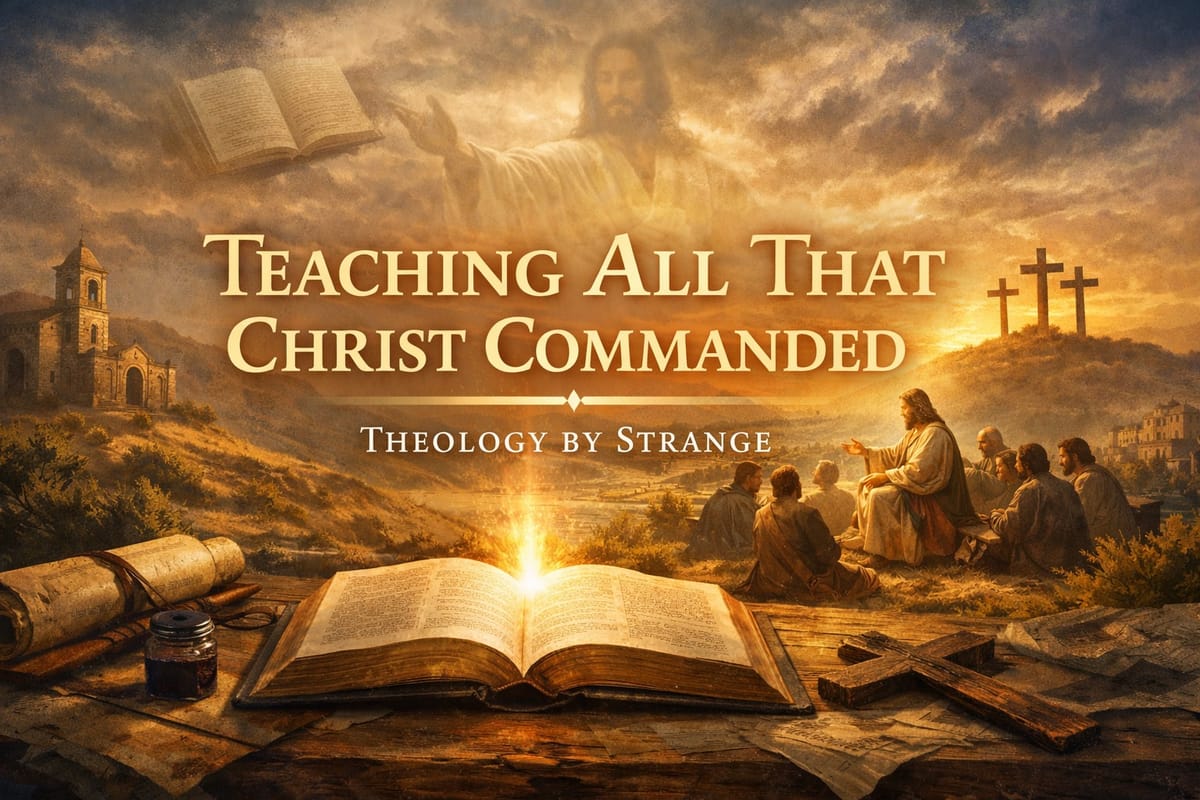
When Jesus gave the Great Commission, He didn’t leave room for selective teaching.
“Teaching them to observe all that I have commanded you” (Matt. 28:20).
That single word—all—carries enormous weight.
At first glance, we might assume Jesus is referring only to His recorded sayings in the Gospels: The Sermon on the Mount, the parables, and the commands to love God and neighbor. And those words certainly stand at the center. But when we read Christ’s command within the wider witness of Scripture, it becomes clear that He meant far more than repeating a few memorable teachings.
Jesus was not starting something new that stood apart from God’s prior revelation. He was bringing it to fulfillment.
Luke hints at this larger reality in the opening line of Acts, where he describes his Gospel as an account of “all that Jesus began to do and teach” (Acts 1:1). That wording matters. If the Gospel records what Jesus began to teach, then His instruction did not end with the resurrection or the ascension. The risen Christ continued to teach His Church through the apostles—by the power of the Holy Spirit.
This is why the New Testament letters are not optional commentary or secondary reflections. The apostles understood themselves to be speaking with Christ’s own authority. Paul says it plainly: “The things I am writing to you are a command of the Lord” (1 Cor. 14:37). That is a staggering claim. It means that the Epistles stand alongside the Gospels as Christ’s authoritative instruction to His Church.
In other words, when the Church teaches the letters of Paul, Peter, John, or James, it is not moving away from Jesus—it is listening to Him.
This helps us see why the Great Commission binds the Church not just to the Gospels, but to the whole of Scripture. The same Spirit who empowered the apostles is the Spirit who inspired the prophets. All Scripture is “breathed out by God” and given for the equipping of God’s people (2 Tim. 3:16–17). Even the Old Testament, Peter reminds us, pointed forward to Christ through the Spirit of Christ at work within the prophets (1 Pet. 1:10–12).
Theologian Herman Bavinck captured this beautifully when he wrote, “Revelation is organic; all parts form a living unity that culminates in Christ. He is the content and fulfillment of all revelation.”
That vision protects us from reducing the Great Commission to a slogan or reducing Christianity to a list of moral lessons. Jesus did not command His Church to teach a handful of ethical principles. He commanded her to teach everything God has revealed, understood in the light of Christ.
From creation to new creation, from promise to fulfillment, from law to gospel—Scripture tells one unfolding story, and every part bears witness to Him. Jesus Himself said as much: “These are the Scriptures that testify about Me” (John 5:39).
To teach all that Christ commanded, then, requires more than sound bites or surface-level familiarity. It calls the Church to immerse herself in the whole counsel of God—to wrestle with the text, to understand its history and theology, and to let the Word shape not only what we say, but who we become.
The mission of the Church is not merely to pass along isolated truths. It is to proclaim the full story of redemption—the story that finds its center, meaning, and completion in Jesus Christ. That is the task Christ gave His Church. And by His Spirit, it is the task He still empowers us to carry out.
Christ does not call His Church to partial obedience or selective teaching, but to a whole-Bible faith centered on the whole Christ.
— Zach Strange
If you’ve found this post helpful, consider subscribing and becoming a member of Theology by Strange. New essays explore Scripture, theology, and the Christian life with depth, clarity, and reverence—always anchored in God’s Word and written for the Church.