
Material Ontology and the Chair
Why modern Christians often confuse existence with matter - and how Scripture offers a richer vision of reality grounded in God's purpose.
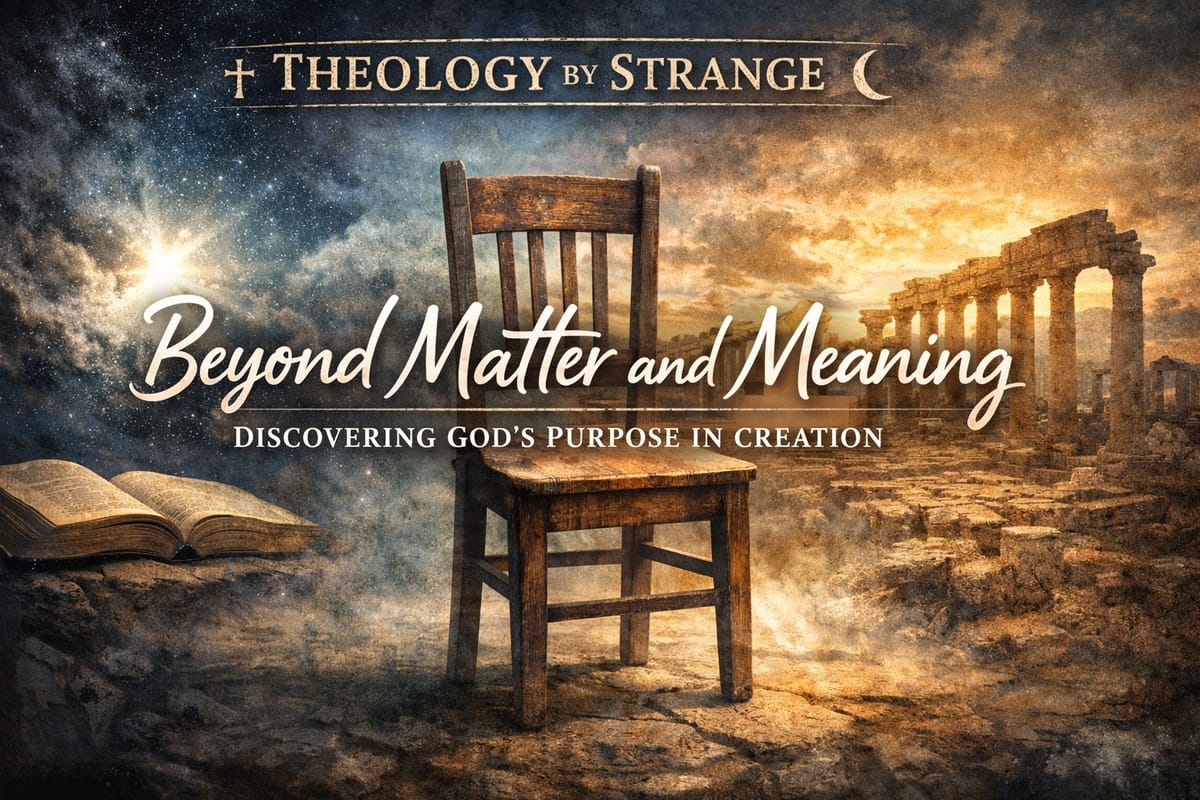
Most of us move through the world with an assumption we rarely stop to question: something exists because it is made of matter. If it has physical properties—if it takes up space, has weight, and can be touched—then it is real. This way of thinking is so normal to us that it feels like common sense.
Take a chair.
When we say that a chair exists, we usually mean that it can be located in a room, seen with our eyes, and described by its physical components. It has legs, a seat, and a back. It might be made of wood, metal, plastic, or fabric. You can sit on it, measure it, weigh it, and—if you’re so inclined—take it apart to examine how it’s built.
From a modern Western perspective, the chair is real because it is materially present. Its existence is confirmed by our senses and explained through scientific analysis. We can describe it in terms of molecules, atoms, and even subatomic particles. The more thoroughly we can break it down into measurable parts, the more confident we feel that we have explained what it is.
This instinct didn’t appear out of nowhere. It has been shaped over centuries by materialist philosophy and the success of the natural sciences. Since the Enlightenment, Western culture has increasingly trained us to equate reality with what can be empirically observed, tested, and verified. To explain something fully, we assume, is to explain its physical composition.
Within this framework, existence and matter become almost identical. If the material structure of the chair were denied, its existence would be denied as well. What cannot be seen or measured is often treated as less real—or not real at all. As philosopher Conrad Hyers notes, this way of thinking defines existence in terms of substance rather than purpose or role within an ordered whole (Hyers, The Meaning of Creation, 14–18).
Because this assumption is so deeply embedded in us, it rarely draws attention. If someone were to ask, “Does the chair exist?” we wouldn’t pause to reflect on its role or meaning. We would think immediately of its physical presence: Yes, of course it exists. You can see it. You can touch it. For the modern imagination, existence and physicality are virtually synonymous.
But what feels obvious to us is not a timeless truth—it is a cultural habit of thought.
In other times and places, the question would have been answered very differently. In the ancient world, something was often said to “exist” not because of what it was made of, but because of what it did. A chair existed because it fulfilled its purpose: it provided a place to sit. Its reality was bound up with its function within an ordered world, not merely with its material components.
This older way of thinking reminds us that our assumptions about reality are not neutral. Scripture itself frequently speaks this way. In Genesis 1, God does not merely bring material things into being; He orders them, assigns them roles, and gives them functions within His creation. Light separates day from night. The sun and moon govern time. Humanity is given a vocation. Creation is declared “good” not simply because it exists, but because it is ordered according to God’s purposes.
When we assume that reality is nothing more than matter, we risk flattening the biblical vision of the world. The chair becomes nothing more than atoms arranged a certain way, rather than an object designed for a role within human life. And once that assumption takes hold, it quietly reshapes how we think not only about furniture, but about creation, meaning, and even God’s activity in the world.
Recognizing this doesn’t require us to reject science or deny material reality. It simply asks us to recover a more biblical way of seeing—a way that understands existence as purposeful, ordered, and grounded in God’s word, not merely in measurable substance.
Reality is not held together by matter alone, but by the word and purpose of God.
— Zach Strange
If you found this reflection helpful, consider subscribing to Theology by Strange. New essays explore Scripture, doctrine, and the biblical vision of reality—written for thoughtful Christians who want depth without pretense. Subscribing helps sustain the work and ensures you don’t miss future posts.